
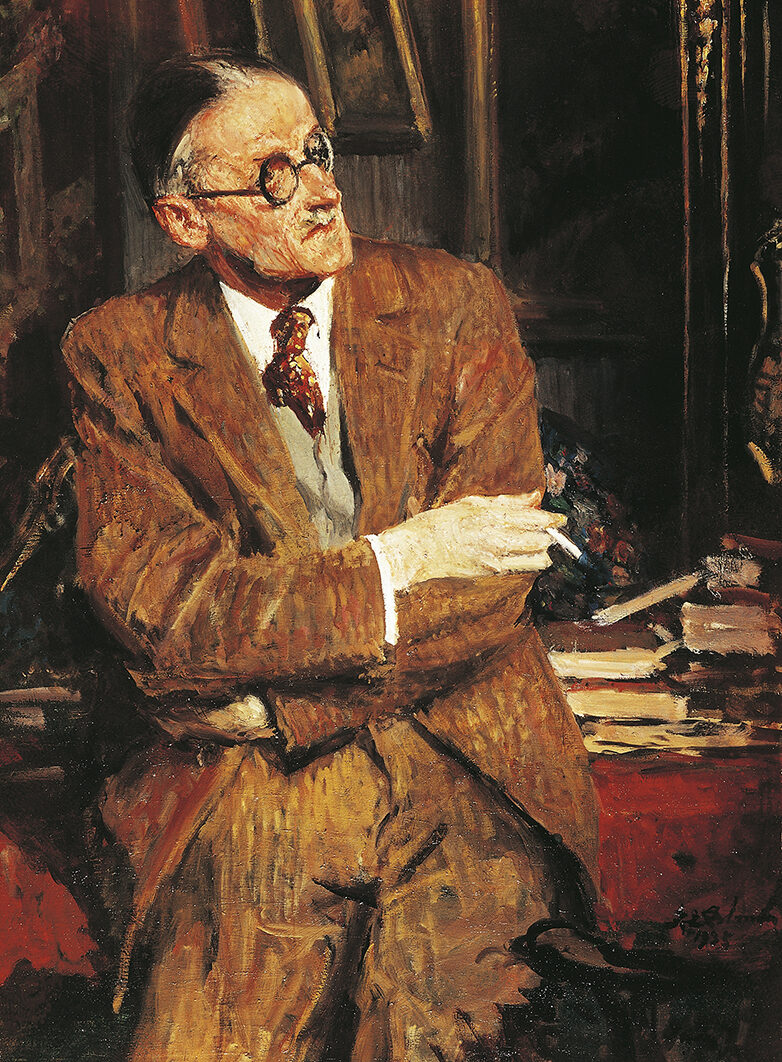
Predictably, Jessie Buckley has won the Oscar for her portrayal of Shakespeare’s wife grieving over the death of their son Hamnet. Scholars (including me, here) have expressed scepticism as to whether there is any connection, beyond a coincidence of names, between the boy’s death and the play Hamlet. “Shakespeare,” wrote the great Romantic critic William Hazlitt, “was the least of an egotist that it was possible to be.” That is to say, he was a chameleon, changing his colour to suit every character he conjured into life, not an author of 21st century autofiction, channelling his own experience into his plays. But it must be admitted that Maggie O’Farrell, author of the novel Hamnet, was not the first Irish novelist to make the connection. The hype around the film sent me back to her probable source: not Shakespeare’s play, but a scene set in the National Library in Dublin. The “Scylla and Charybdis” episode of James Joyce’s Ulysses.
Wondering whether anyone else had made the connection, I idly put the names Joyce, Ulysses and Hamnet into an X search. And indeed up came a link to an excellent article on this very subject, published in the Irish Times last week by Daniel Mulhall, former ambassador of Ireland to the United States (he must be rather relieved that he now writes essays about Irish literature instead of sitting in Washington DC trying to explain the Irish position on the war). Mulhall quotes the theory of Stephen Dedalus, Joyce’s persona in the novel, that Hamlet is Hamnet and that – as in the Hamnet film – the ghost of old Hamlet is played by Shakespeare himself: “He speaks the words to Burbage, the young player who stands before him… Hamlet, I am thy father’s spirit… To a son he speaks, the son of his soul, the prince, young Hamlet and to the son of his body, Hamnet Shakespeare, who has died in Stratford that his namesake may live for ever.” What Mulhall does not mention is that Joyce was actually building a fantasia upon a theory, drawn from late 19th-century biographies of Shakespeare, that he had already articulated in some lectures on the play that he gave in Trieste.
But Ulysses is what scholars called a multivocal novel. At the end of the debate in the National Library, Stephen is asked whether he believes his own theory. To which he promptly answers “No.” And when the theory is first mentioned, early in the novel, it is in the form of a takedown, voiced by another character, “stately, plump Buck Mulligan”: “He proves by algebra that Hamlet’s grandson is Shakespeare’s grandfather and that he himself is the ghost of his own father.” It’s both an ingenious theory and a joke, a parody of academic convolution.
And that’s the genius of Ulysses. It can be read in so many ways simultaneously. This is one of the reasons why for a century it has attracted as much opprobrium as admiration. So I was not entirely surprised that my Joycean X-search also threw up such freshly-minted literary critical appraisals as

@megha_lilly: Ulysses is the biggest piece of trash writing that fugly gay communist academia has shoved down everyone’s throat because it’s all one weak Jewish guy dismantling the entire western spirit of heroism and virtue.
“Megha”, who we may assume is Maga, offers us a – how shall we say, slightly less nuanced? – version of a critique in the tradition of Virginia Woolf, writing in her diary on 16 August 1922, shortly after the novel’s publication:
I should be reading Ulysses, & fabricating my case for & against. I have read 200 pages so far—not a third; & have been amused, stimulated, charmed interested by the first 2 or 3 chapters—to the end of the Cemetery scene; & then puzzled, bored, irritated, & disillusioned as by a queasy undergraduate scratching his pimples. And Tom, great Tom [T. S. Eliot, that is], thinks this is on a par with War & Peace! An illiterate, underbred book it seems to me; the book of a self taught working man, & we all know how distressing they are, how egotistic, insistent, raw, striking, & ultimately nauseating.
To be fair to Woolf, she subsequently recognised that, for all the differences of class and tone, Joyce was doing something similar to what she was attempting at the same time in Mrs Dalloway: “to record the atoms as they fall upon the mind in the order in which they fall” and to create inventive fiction out of “an ordinary mind on an ordinary day.”
But we need to do a little more to “fabricate the case for.” It might go like this.
“Underbred,” said Woolf; “trash,” says Megha. Woolf was a snob; Megha, as well as being an anti-Semite, is an inverted snob: she takes a term usually applied to lowbrow fiction and applies it to a work that is supremely, self-consciously literary. What both responses share, beneath their very different registers of snobbery, is an impatience with a book that refuses to do the work for you (hence Woolf’s “puzzled, bored, irritated”). Joyce once told a friend that he had put so many enigmas and puzzles into Ulysses that it would keep the professors busy for centuries—which was, he added, the only way of ensuring one’s immortality. This sounds like arrogance. It might also be read as a kind of generosity: the novel as an inexhaustible gift, rather than a product to be consumed and discarded. The difficulty is not an obstacle to the meaning. It is the meaning, or part of it. Life, Joyce understood, does not explain itself as it goes along. Every serious reader of Ulysses knows the experience of returning to a passage that defeated them on first encounter and finding it suddenly luminous. A good example would be the sentence quoted, with admiration, in the tweet to which Megha was replying:
@AmericanGwyn: While he was writing ULYSSES, Joyce told his friend Frank Budgen that he’d spent eight hours working on a single sentence.
The sentence: “The heaventree of stars hung with humid, nightblue fruit.”
A sentence like that becomes beautiful only when you pause and dwell upon it, allowing its resonance to sound in your ear, its radiance to create images in your mind. So much of Ulysses belongs in the province of poetry as much as that of prose.
Then there is the question of structure. Joyce maps his single Dublin day – 16 June 1904, now celebrated annually as Bloomsday – onto Homer’s Odyssey, so that Leopold Bloom’s wanderings through the city shadow those of Odysseus across the wine-dark sea. This could have been a dry academic conceit, the literary equivalent of those Renaissance paintings in which every figure corresponds to a classical virtue. In practice it is anything but. The parallel works as comedy (Bloom eating a kidney for breakfast is Odysseus feasting among the gods), as pathos (his inability to go home to his wife becomes the ache of the exile who can never quite return), and as a kind of democratic heroism. By mapping the wanderings of a middle-aged Jewish advertising agent onto the greatest adventure story in Western literature, Joyce is making an argument: that the epic is not the exclusive property of warriors and kings. An ordinary Thursday in the life of an ordinary man contains multitudes.
That man, Leopold Bloom, is one of the great creations of world literature, and defending him is almost the easiest part of the defence. He is kind, curious, cuckolded, digressive, humane, occasionally ridiculous and deeply sympathetic. He intercedes on behalf of a stranger at risk of a beating. He feeds a stray cat. He thinks, warmly and without self-pity, about his dead son Rudy. He is the necessary corrective to what Megha calls “the western spirit of heroism and virtue,” not because Joyce is dismantling that spirit, but because he is expanding it – insisting that virtue looks less like Achilles and more like a man who buys a lemon soap and worries about his wife.
And the wife. Molly Bloom’s soliloquy, the great unpunctuated monologue that closes the novel, is Joyce’s most audacious gesture and his most misunderstood. It is sometimes read as a male fantasy of female consciousness – all appetite and flow and yes. I have to admit that when I read its climax (I use the word advisedly) aloud to a class of first year students I got both a round of applause and a complaint from a fundamentalist Christian. But Molly is also shrewd, sardonic, mercilessly funny about men and their pretensions. That closing affirmation – “and first I put my arms around him yes and drew him down to me so he could feel my breasts all perfume yes and his heart was going like mad and yes I said yes I will Yes” – is not surrender. It is a recollection of the moment she chose Bloom, and choosing is the operative word, not least because Joyce chose 16 June 1904 as the date of Bloomsday because it was the day of his first serious date with his beloved Nora Barnacle. Virginia Woolf would have rather shuddered to know that the defining moment of the date, following a walk on the south bank of the Liffey, came (I use the word advisedly) when she put her hand down Jimmy’s trousers.
After 750 pages of predominantly male interiority, Joyce hands the last word to a woman, and she uses it to reaffirm desire and life. That Woolf, who created Clarissa Dalloway and Mrs Ramsay, could not initially see this as a kindred enterprise says more about the class anxieties of Bloomsbury than about the limitations of Ulysses. What Joyce achieved, and what no summary can quite convey, is the creation of a prose instrument of almost unlimited flexibility. His mastery of language made him capable within a single chapter of pastiche, parody, lyric intensity, vaudeville, scholasticism and stream of consciousness. And yet for all the cleverness, the novel never loses its fundamental warmth. It is, at bottom, about two people who need each other: the fatherless young man Stephen and the sonless older man Bloom, circling through the same city without quite connecting, the way grief and longing circle without resolution. Like Shakespeare’s wise fools, Bloom speaks fundamental truths:
—But it’s no use, says he. Force, hatred, history, all that. That’s not life for men and women, insult and hatred. And everybody knows that it’s the very opposite of that that is really life.
—What? says Alf.
—Love, says Bloom. I mean the opposite of hatred.
It is not a sophisticated formulation. Joyce knows that. But, like Shakespeare, he also knows – and this is why, a century on, Ulysses still matters – that the unsophisticated answer is sometimes the one that endures.
[Further reading: How academics ruined Shakespeare]
Content from our partners



Related


Join the debate
Subscribe here to commentI love this! I do wish I had had the privilege of being taught by Prof Bate. My years as an Eng Lit student in the early 1970’s were marked by boredom. The slant of the department was a dogged adherence to late Leavisite theories. Fortunately I was not put off reading. I followed Prof Bate’s Shakespeare MOOC, to my great advantage.